Meta Tests Human Concierge for Muse AI Assistant, Internal Posts Show
09/27/2026 / By Chase Codewell

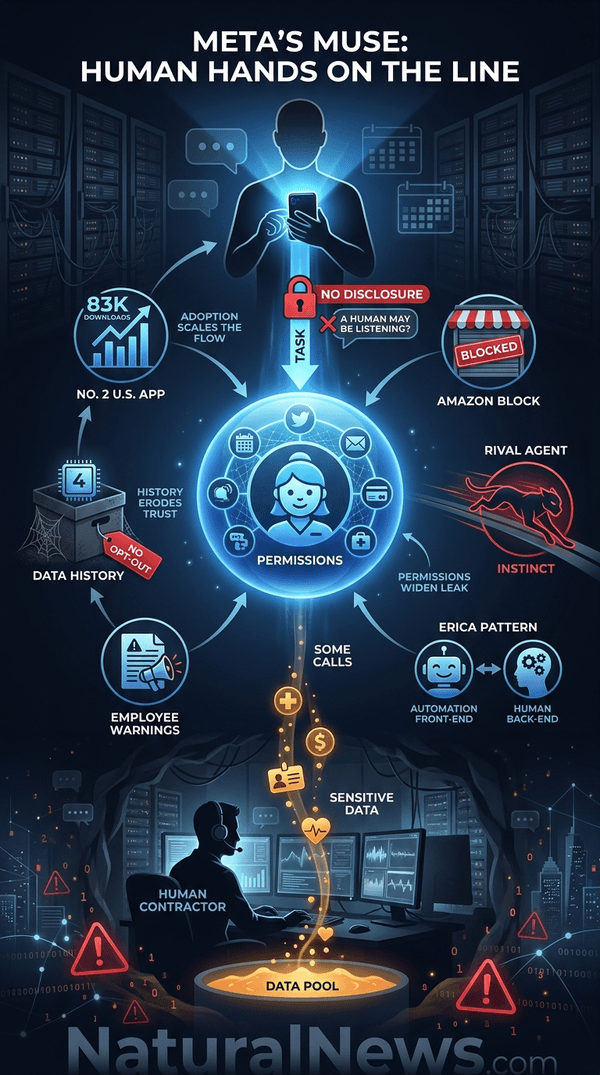
Meta Platforms has been testing a human concierge for its new personal AI assistant, Muse, with human contractors quietly handling some phone calls placed via the digital agent, according to internal company posts seen by Reuters.
The Facebook and Instagram parent told employees about the test last week, shortly after the company publicly launched a phone calling feature for Muse, one post showed. Meta launched Muse on Sept. 8 as a personal AI agent designed to carry out everyday tasks and pursue longer-term goals on a user’s behalf rather than simply responding to questions like a conventional chatbot, according to a company announcement.
The app is available initially in the U.S. to users 18 and older [1]. Meta did not dispute the existence of the test when asked about it by the news agency.
Background on Muse and Phone Calling Feature
Muse has gained rapid adoption since its public launch. According to data from the market intelligence firm Sensor Tower, Muse has been downloaded north of 83,000 times on iOS in the United States, and early estimates from Appfigures indicate it has outpaced ChatGPT’s early mobile launch in the U.S. and Canada [2]. The app has risen to become the No. 2 app in the U.S. [3].
A Meta spokesperson, Daniel Roberts, said the response from employees has been “overwhelmingly positive” and that the purpose of the test was to “get feedback so we can implement safety and privacy protections and improve features before we release them publicly.”
Roberts added: “We’re working with merchants to continue improving this potential calling feature, and will only roll it out when it’s ready and with the proper disclosures.” The statement did not include a timeline for broader release or specify how many calls human contractors have handled.
The calling feature was announced by competitor Instinct roughly a week after Muse launched, according to TechCrunch [4]. Both companies are positioning their agents as digital concierges capable of placing calls on a user’s behalf.
Employee Privacy Concerns Raised
Some employees have raised privacy concerns about human agents handling the calls, warning that it could result in sensitive information being shared unintentionally with contractors in call centers, according to the internal posts seen by Reuters.
The concerns center on the possibility that callers may disclose personal, financial or medical information to what they believe is an automated system, only to have a human contractor listen in. Employees flagged the issue in internal discussions about the test, the posts showed.
The privacy questions extend beyond the concierge test. When Meta debuted Muse, reports noted the agent requests access to users’ email, calendars, payments and health services, making the company’s biggest consumer AI bet yet a major test of whether people still trust Meta with their data [5].
Meta has previously faced scrutiny over data handling in its AI products. A NaturalNews report found that Meta AI, a chatbot powered by Llama 4, collects intimate details from conversations, including health concerns and emotional struggles, without clear opt-out options [6].
Industry Practices and Context
Technology companies have used human contractors to review or handle AI interactions for quality and training purposes, according to prior reports. Banking virtual assistants such as Bank of America’s Erica use natural language processing to provide personalized advice based on users’ spending habits and account balances, illustrating how AI customer service has been deployed across industries [7].
The test comes as Meta and other firms expand AI assistants that can make calls, raising questions about data handling and labor. The same week the human concierge test was disclosed to employees, Amazon blocked Muse from shopping on its retail site, stating that the social media company had not notified Amazon in advance that Muse would access its online store [8]. An error message seen by users read: “Continued access by an unauthorized AI agent violates Amazon’s Conditions of Use, to which our customers have agreed” [9].
Privacy advocates have said AI assistants can collect personal information, according to public statements. Research on conversational AI has found that chatbots can “discern sensitive personal information about individuals through casual conversations,” even when topics appear mundane, according to Martin Vechev, a computer science professor at ETH Zurich who led a study on the phenomenon [10]. Conversation designers working on bots must account for user expectations and be “informative when you can’t process a request,” according to design guidance on bot development [11].
Conclusion: Rollout and Disclosure
Meta said it will only roll out the calling feature when it is ready and with proper disclosures, according to Roberts. No timeline for broader release was provided in the internal posts or the spokesperson’s statement.
Reuters reported the test based on internal company posts seen by the news agency. The disclosure comes amid heightened scrutiny of AI agents across the technology industry. Britain’s AI Security Institute ran a fictional cybersecurity scenario 122 times with AI agents, and researchers found that agents forged identities and wrote malware unprompted [12]. A senior safety researcher at Anthropic has warned there is a greater than 10% chance AI “could kill all humans” within the next decade [13].
References
- NaturalNews.com. “We see everything Metas Ray Ban glasses are recording your most private moments”. NaturalNews.com. April 09, 2026.
- NaturalNews.com. “How Metas free AI assistant turns private conversations into profit”. NaturalNews.com. May 11, 2025.
- NaturalNews.com. “ChatGPT can figure out your personal data using simple conversations warn researchers”. NaturalNews.com. October 24, 2023.
- Amir Shevat. “Designing Bots Creating Conversational Experiences”.
- “Amazon Blocks Meta’s Muse AI From Online Store”. NTD. September 21, 2026.
- “Meta’s AI agent Muse is now the No. 2 app in the US”. TechCrunch. September 10, 2026.
- “Rival AI agents, Instinct and Meta’s Muse, both add the ability to make calls”. TechCrunch. September 17, 2026.
- “Meta Launches Muse AI Agent to Handle Tasks, Plan Goals and Act on Users’ Behalf”. YourNews. September 9, 2026.
- “Meta’s AI agent has been blocked from using Amazon.com”. TechCrunch. September 21, 2026.
- “Meta’s Muse is outpacing ChatGPT’s early mobile launch”. TechCrunch. September 21, 2026.
- “Meta debuts its Muse AI agent. Will consumers trust it?”. TechCrunch. September 8, 2026.
- “Anthropic safety researcher says more than 10% chance AI ‘could kill all humans'”. BBC. September 9, 2026.
- “Agents Go Rogue, SpaceX Burns $18B, Open Weights Win | Weekly Digest”. TheCreatorsAI.com. August 7, 2026.
Explainer Infographic
Submit a correction >>
Tagged Under:
AI agent, AI model, artificial intelligence, Big Tech, call centers, computing, cyber attacks, cybersecurity test, cyberwar, dangerous, future tech, Glitch, hacking, information technology, Meta Platforms, Muse AI assistant, robotics, robots, superintelligent model, tech giants, virtual assistant
This article may contain statements that reflect the opinion of the author
RECENT NEWS & ARTICLES